Showing posts with label google. Show all posts

Google New Search Index System: Caffeine

Last time when Google announced soon to be released Index system termed as Caffeine it created lots of buzz in blogosphere as this new search indexing system brought lots of changes in search engine ranking.Technically I have seen lots of changes in my search engine traffic in last few weeks. Probably an effect of Caffeine or because of quality content. What ever it is today Google announced the completion of their new Search indexing system Caffeine.
Google also explained why they needed this new system and how is Caffeine different from old indexing system:
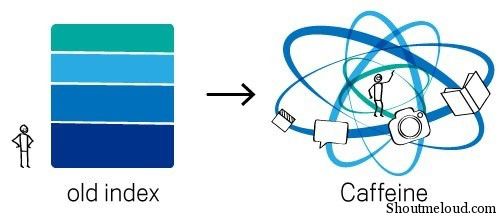
google-caffeine
Our old index had several layers, some of which were refreshed at a faster rate than others; the main layer would update every couple of weeks. To refresh a layer of the old index, we would analyze the entire web, which meant there was a significant delay between when we found a page and made it available to you.
With Caffeine, we analyze the web in small portions and update our search index on a continuous basis, globally. As we find new pages, or new information on existing pages, we can add these straight to the index. That means you can find fresher information than ever before—no matter when or where it was published.
Seems like Google search is undergoing lots of changes and few of recent changes are :
Background Image in Google and Google new search look.
Do let us know your recent search experience using Google? Are you enjoying new look and feel of Google or you using any alternative search engine?
Resource :  shoutmeloud.com

Google phases out Microsoft Windows use


London: Web search group Google Inc is phasing out internal use of rival Microsoft Corp's Windows operating system because of security concerns following a Chinese hacking incident, the Financial Times reported on Tuesday.


Citing several Google employees, the FT said the decision to move to other operating systems including Apple Inc's Mac OS and open-source Linux began in earnest in January after Google's Chinese operations were hacked.


Internet security firm McAfee Inc said at the time the cyber attacks on Google and other businesses had exploited a previously unknown flaw in Microsoft's Internet Explorer browser, which was vulnerable on all recent versions of Windows.


FT quoted one Google employee as saying: "We're not doing any more Windows. It is a security effort." Another said: "Getting a new Windows machine now requires CIO (chief information officer) approval."
Google said in a statement: "We're always working to improve the efficiency of our business, but we do not comment on specific operational matters."


Google, which already offers e-mail, Web and other software products that compete with Microsoft's offerings, is developing its own operating system based on its Chrome browser. It will initially target netbooks, or inexpensive, pared-down notebook PCs.


Microsoft Windows runs about nine out of 10 of the world's personal computers.


Courtesy : IBNLive

Google adds satnav to Maps on Android mobiles


Google today added a fully featured GPS satellite navigation service to its Google Maps application for mobile phones running its Android operating system.


The new service, for the UK and Ireland, follows a similar launch in the United States last year. The new Google Maps Navigation brings all of the firm's mapping services together, including the controversial Street View, and features full voice guidance.


The service also offers voice control, allowing users to bypass the often tedious step of inputting an address or postcode by simply saying where they want to go.

Speaking at the launch this morning, Steve Lee, Google’s Group Product Manager for Mobile Maps, said that mobile map use is growing with the spread of smartphones and cheaper data contracts. He said that 50 million people now use Google Maps on their mobile phones every day. Google’s new service, like many of the company’s products, is based in “the cloud”. No maps are installed on a user’s device; instead, the Android phone accesses Google’s vast banks of online data, enabling updates such as traffic information to be delivered in real time.

“The advantage that gives us,” Mr Lee said, “is that we have access to the whole of Google search. Even if you don’t know the name ofthe place you are going, we can still find it.” A voice search of “navigate to Rosetta Stone” quickly offered the British Museum’s address.
Google’s move into fully fledged satellite navigation also has wider significance, since it marks another field - after mobile phones - where the company is entering a market already occupied by highly profitable companies such as TomTom, and undermining their business model by making previously paid-for information or technology freely available.

However, TomTom denied that Google’s satnav solution would damage its market. A spokeswoman said: “This is a different type of device for a different type of consumer. The Google Maps service has been available in North America for some time and we have noticed no impact on our business. In a way, it’s like digital cameras. Most phones have them built in, yet people still buy separate cameras for their dedicated functionality.”

Although the new Google system is currently only available for Google’s Android platform, Mr Lee said that development for other platforms, such as BlackBerry and iPhone, will almost certainly take place.

The system’s main weakness, he acknowledged, is that motorists using their Google Maps satnav in Europe will be forced to pay data roaming charges. He suggested that users on holiday download a route using wireless broadband internet before setting out, and then turn off data roaming to avoid racking up a huge bill.


Google Acquires App Publisher Labpixies


Google on Tuesday added to its acquisition roster with the purchase of Labpixies, which publishes Web and mobile applications.
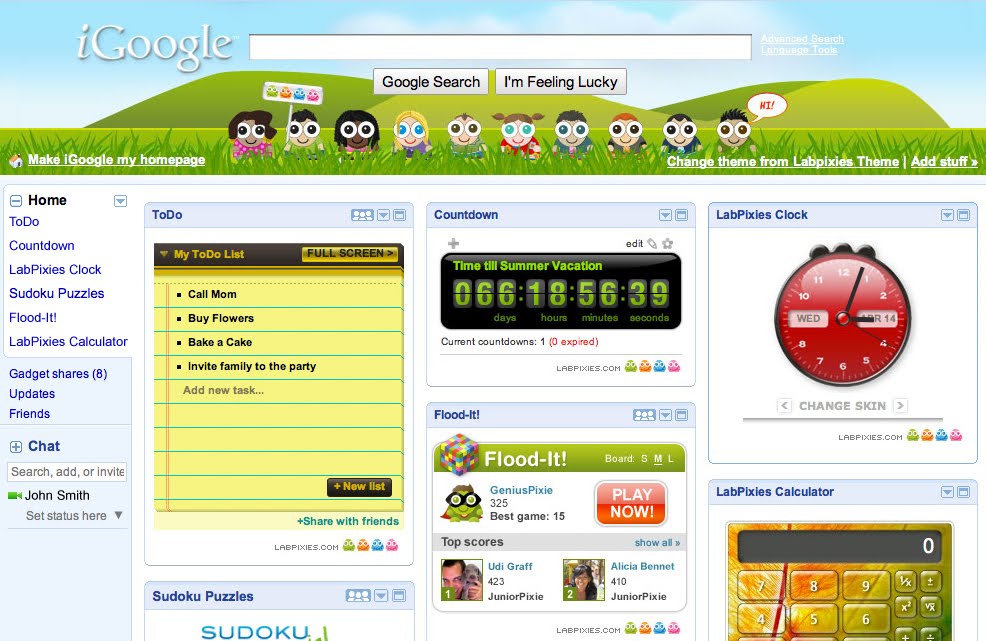
Labpixies was one of the first companies to create gadget for iGoogle back in 2005.
"Over the years, we worked closely together on a variety of projects, including the launch of a number of global OpenSocial based gadgets," Dan Loeb with the iGoogle team wrote in a blog post. "Recently, we decided that we could do more if we were part of the same team, and as such, we're thrilled to announce the acquisition of Labpixies."
The Labpixies team will be based in Google's Tel Aviv office and will focus on iGoogle efforts across Europe, the Middle East, and Africa, Loeb wrote.
"We both felt the time was right to come together," Labpixies wrote on its Web site. "We started Labpixies to create a truly personalized online experience and develop fun widgets that people find useful every day. Working at Google will help us scale to more users as well as giving our team greater opportunities."
"The acquisition is an opportunity to learn from each other to bring more apps to users, help developers and improve the overall developer ecosystem," Labpixies said.
Labpixies said there are no plans to change current products, but the company will evaluate this over time.
Labpixies is the latest in a string of small acquisitions for Google. This year, Google has acquiredvisual search company Plinkpurchased iPhone e-mail app ReMail, photo-editing site Picnik, and platform services company Episodic.
Last year, Google acquired mobile display advertising firm AdMob, display ad company Teracent, and CAPTCHA test company reCaptcha.

Google Is Now Apple’s Greatest Enemy: Here’s Why

Let’s take a trip back in time. The year is 1994, and two tech giants are going to war over copyright. They are Microsoft and Apple, and they are fighting over a copyright claim by Apple over Microsoft and HP’s use of graphical user interface elements from the Macintosh OS. The resulting court case, Apple Computer, Inc. v. Microsoft Corporation, ended with a ruling in Microsoft’s favor, mostly due to a contractual license agreement between the two.

The matter was never fully settled by the case though. Instead, negotiations that took place several years later resulted in the two companies agreeing to make Internet Explorer Mac’s default browser. Microsoft also agreed to keep developing Office for the Mac. Most importantly though, Microsoft invested $150 million into Apple to keep it afloat.

This series of events, which happened while Steve Jobs was being reinstated as the CEO of Apple, set the stage for what is happening today between Microsoft, Apple, and Google (). While Microsoft and Apple are still bitter rivals, several recent events have inadvertently brought them closer together in order to fight their common enemy: Google.

The phrase “the enemy of my enemy is my friend” comes to mind. Let’s explore how we got to this tipping point.


Android: Google Enters Apple’s Turf


When Google CEO Eric Schmidt joined Apple’s Board of Directors in 2006, the move made perfect sense. Here’s what Apple said about Eric in its original announcement:

“Eric’s 20 years of experience as an Internet strategist, entrepreneur and technologist give him a well-seasoned perspective which perfectly complements Google’s needs as a young and rapidly growing company with a unique corporate culture.”

At that time, Google wasn’t in mobile, hardware, operating systems, or browsers. Now Google is directly competing with Apple through the Nexus One, Google Chrome, Chrome OS, and even possibly in the tablet computer space.

It all started with Android (), though. Back in August 2007, details began to leak about Google building a mobile OS or even a GPhone. It turned out to be Android, the open-source mobile OS that is now the fastest growing smartphone OS on the market.

At first, Android didn’t pose much of a threat, but as more phones utilized the software, the relationship between Google and Apple became very uncomfortable. Eric Schmidt sat out board meetings discussing the iPhone due to conflict of interest, but the relationship only eroded from there.


Watershed Moment: Eric Schmidt Resigns from Apple’s Board


Tensions between the two companies grew worse after Apple rejected Google Voice as an app on the iPhone.

The resulting FCC inquiry, along with an FTC investigation and the announcement of Google Chrome OS were just too much. On August 3rd, 2009, Eric Schmidt resigned from Apple’s Board of Directors.

In retrospect, this was the moment when Apple, Google, and the rest of the world realized that the two companies could no longer be allies. Google’s expanding interest outside of search was pouring over into Apple’s domain on multiple fronts. With the search giant free of its Apple association, it could go all-out on its agenda to bring more people onto the web for longer (read the Google Revenue Equation to learn why).

The culmination of the breaking of the Google-Apple alliance? It was the release of the Nexus One, a direct competitor to Apple’s lucrative iPhone.


Recent Events: Apple and Microsoft Talk Bing


Yesterday we learned that Apple and Microsoft are in talks to make Bing () the default search engine for the iPhone. While we’ve heard this rumor before, the talk seems to be heating up. Most of our readers expressed their dismay or shock over the potential deal, some questioning why Apple would ever team up with Microsoft over Google.

Really though, the deal makes perfect sense, given the new competitive landscape. Earlier today, Jim Goldman at CNBC provided some interesting new information on the dynamics of the Apple-Google-Microsoft relationship. According to his source, Steve Jobs hates Eric Schmidt (it wouldn’t surprise us) and Microsoft is offering a bigger cut of iPhone search revenues than Google.

While Microsoft and Apple’s relationship grew cold after the Redmond, WA company bailed Apple Computer out, it never vanished. Moreover, Steve knows that he can work with Microsoft, especially if it helps Microsoft hurt Google.

Android has become the de-facto alternative to the iPhone OS, and the Nexus One is closest thing yet to a smartphone that can stand up to the iPhone’s dominance. While Microsoft and Apple are still in competition over Mac vs. PC, Apple clearly believes that its future isn’t just in computers, but in other Internet devices such as the iPhone and the fabled Apple Tablet. Microsoft poses far less of a threat in these areas than Google does.

It’s time to call it: Google is now Apple’s greatest enemy. Soon Google will be entering its OS turf with Chrome OS. Apple increasingly sees Google as a major competitor over the next few years. While the company Steve built doesn’t particularly like Microsoft, it knows that it has to work with the lesser of two evils in order to succeed.

Say hello to the new dynamic. It’s Apple + Microsoft vs. Google. May the new battle begin.
Posted via web from vigneshwaran's posterous

Youtube expands its HTML5 experiment

Quite a while back Google launched a demonstration of what YouTube would look and function like if it used HTML5's video tag instead of the Flash player. The single page demo showcased a video which seemed indistinguishable form the Flash player, until you tight clicked the video and realized that no Flash player was involved.

The HTML5 demo page used to be accessible via http://www.youtube.com/html5, which now instead offers a page which allows you to join the HTML5 experiment.

YouTube is now making available an HTML5 version of its entire catalog -- well, almost --  of videos when you join the experiment. However the catch is, the video will be streamed in the H.264 format, which if you know is not supported in the Firefox browser. 

The HTML5 <video> tag specification is still conspicuously missing a standard for a video codec. While there has been a huge push for the standardization of a format such as Theora, especially from the browser vendors Opera and Mozilla, however Nokia and Apple had doubts about the formats. Apple made the point that H.264 was already a more popular and supported format, which is quite valid. Concerns were also raised about the existence of unknown patents on technologies used by Theora and Ogg.

As such, with no standardized format recommendation browsers are free to implement a format of their choice. Currently the important players seem to be H.264, and Theora, and Theora as a format is supported on all browsers due to its open nature, which H.264 is present in Chrome and Safari.

This means that as for now, YouTube's HTML5 feature will only work on Safari, Google and Chrome Frame on Internet Explorer, sorry Firefox users. This limitation, along with the fact that the new HTML5 based player wont work with videos having annotations, ads or captions, is something that Google will address over time. Hopefully, soon YouTube will become a fully HTML5 compatible website with support for Theora as well. 

YouTube is not the first the introduce HTML5 based videos though, as DailyMotion launched this experiment quite a while back, and http://tinyvid.tv/ is a website which exclusively caters HTML5 videos.

While the move to HTML5 is excellent surely, a standard video format still needs to be defined, and an open patent unencumbered format is the dire need of the web. Hopefully Google's acquisition of On2 will bear some fruit?

Posted via web from vigneshwaran's posterous

GoogleGoogleGoogleGoogle : 4 In 1


Recently I came across this new site GoogleGoogleGoogleGoogle, in this site you can browse four sites in single webpage. This idea of four Google iframes in one page is by Alex and Erty. It is funny and also useful to search four queries at a same time without switching tabs in the web browser.


You can open other sites by clicking the green arrow at the top left corner on the frame. Also you can close the unwanted frames.


However, you can’t visit certain sites like GmailYahoomailTwitterGoogle Wave. This is because these websites do not allow iframes to be opened.