Google adds satnav to Maps on Android mobiles


Google today added a fully featured GPS satellite navigation service to its Google Maps application for mobile phones running its Android operating system.


The new service, for the UK and Ireland, follows a similar launch in the United States last year. The new Google Maps Navigation brings all of the firm's mapping services together, including the controversial Street View, and features full voice guidance.


The service also offers voice control, allowing users to bypass the often tedious step of inputting an address or postcode by simply saying where they want to go.

Speaking at the launch this morning, Steve Lee, Google’s Group Product Manager for Mobile Maps, said that mobile map use is growing with the spread of smartphones and cheaper data contracts. He said that 50 million people now use Google Maps on their mobile phones every day. Google’s new service, like many of the company’s products, is based in “the cloud”. No maps are installed on a user’s device; instead, the Android phone accesses Google’s vast banks of online data, enabling updates such as traffic information to be delivered in real time.

“The advantage that gives us,” Mr Lee said, “is that we have access to the whole of Google search. Even if you don’t know the name ofthe place you are going, we can still find it.” A voice search of “navigate to Rosetta Stone” quickly offered the British Museum’s address.
Google’s move into fully fledged satellite navigation also has wider significance, since it marks another field - after mobile phones - where the company is entering a market already occupied by highly profitable companies such as TomTom, and undermining their business model by making previously paid-for information or technology freely available.

However, TomTom denied that Google’s satnav solution would damage its market. A spokeswoman said: “This is a different type of device for a different type of consumer. The Google Maps service has been available in North America for some time and we have noticed no impact on our business. In a way, it’s like digital cameras. Most phones have them built in, yet people still buy separate cameras for their dedicated functionality.”

Although the new Google system is currently only available for Google’s Android platform, Mr Lee said that development for other platforms, such as BlackBerry and iPhone, will almost certainly take place.

The system’s main weakness, he acknowledged, is that motorists using their Google Maps satnav in Europe will be forced to pay data roaming charges. He suggested that users on holiday download a route using wireless broadband internet before setting out, and then turn off data roaming to avoid racking up a huge bill.


The 'iPad killer' made in India !

Apple's iPad was, it's fair to say, awaited with the kind of breathless anticipation usually reserved by nubile nymphets for rakish rockers. But even as consumers rave about it, the technoscenti are already looking ahead ─ to a product that could make the iPad seem outdated, and, what's more, is completely Made in India.

India is, of course, regarded as a software superpower but hasn't really made waves in IT hardware so far. That could soon change, thanks to the Adam tablet PC of Hyderabad-based Notion Ink. Adam has generated enormous buzz on tech websites and gadget blogs ever since an early prototype was first demonstrated at the CES (Consumer Electronics Show), the world's largest consumer tech trade show in January this year. Today, the final product minus the custom user-interface will be showcased at the Mobile World Congress in Barcelona, where the finest minds of geekdom will be congregating to check it out. But first, we persuaded the company to show it to us at the BVRIT Innovation Centre in Hyderabad, where they are based. 


Never heard of Notion Ink? Its founders are six IITans and an MBA grad. With an average age of 24, they believe India has what it takes to compete with the most innovative tech companies in the world. “We knew that Indian engineers and designers were doing most of the innovative work at Microsoft, Intel, and Apple. We just needed to take the first step," says co-founder Rohan Shravan.

“Current PC technology is like a Hummer on a city road,” quips Rohit Rathi, the youngest of the group at 23, and, along with Shravan, one of four co-founders from IIT Kharagpur. Two are from IIT Delhi while Sachin Ralhan, the eldest at 25, is a childhood friend of Shravan and Rathi and an MBA from IIPM. Apart from Ralhan and Rathi, the other five are all aged 24.

What's so different about their tech? Three years in the making, the Adam tablet is the first device in the world to integrate two breakthrough power saving components - nVidia’s Tegra 2 chip and a PixelQi screen. Together, they help it achieve twice the battery life and performance of the iPad.

“The chip provides an edge over the iPad with its ability to play full high definition videos and Flash on the web browser. It can offer the performance of a computer with the power consumption of a cellphone,” explains Shravan.

Adam’s 10-inch screen integrates many innovations first used in the $100 OLPC (one laptop per child) project. Unlike traditional screens, PixelQI screen has a dual mode, and can be read in bright sunlight like an e-reader. With the backlight off, the company claims that it can increase battery life between charges by a factor of five.

What about the pricing? The company has not yet taken a decision on this crucial aspect, but is clear that Adam will definitely be competitive vis-a-vis Apple's iPad. It expects to start retail sales, at first in the USA, from July onwards.

Notion Ink worked with National Institute of Design’s R&D development campus in Bangalore to build a unique touch interface that runs on Google’s Android mobile operating system. As a startup, it faced many obstacles in filing patents and finding the right engineering talent. “India doesn’t have people working on Android. And the companies that have, charge Rs 1 lakh per resource per month,” says Rohan. “So we came up with a social solution - We opted to train engineers ourselves.” 


The company trained and then recruited over 50 engineers at BVRIT in Bachupally, Hyderabad. “We got the infrastructure at their Innovation Center, and the students as well. We knew the technology in and out and started training them. Within two months it started paying off, and we started developing the professional applications for the product we wanted to design.”

The company is working on an application store platform of its own, where users can find a wide variety of content. “It will offer everything from apps, books, video, audio, to magazines, newspapers and comics,” says co-founder Rajat Sahni. 


For more pics: http://www.flickr.com/photos/47467738@N05/sets/72157623302198493/show/


The company sees more and more users reading newspapers on e-readers and tablets in the near future, and has designed a lightweight product that adapts well to this purpose. They showed us a version of how a digital magazine would look on the Adam. “We’ve taken design inspiration from a 400-year tradition - the user interface of magazines!” chuckles Shravan. 


The men behind Adam

Rohan Shravan- IIT- KGP (2008)
Rohit Rathi - IIT- KGP (2008)
Sachin Ralhan – IIPM
Mohit Gupta - IIT- KGP (2008)
Anirudh Gupta –IIT Delhi (2007)
Rajat Sahni – IIT Delhi (2007)
Devanshu Agrawal - IIT- KGP (2008) 


- Courtesy Times of india 

MIT Student Invents Blood Sucking Plunger That Could Speed Up Healing for Millions


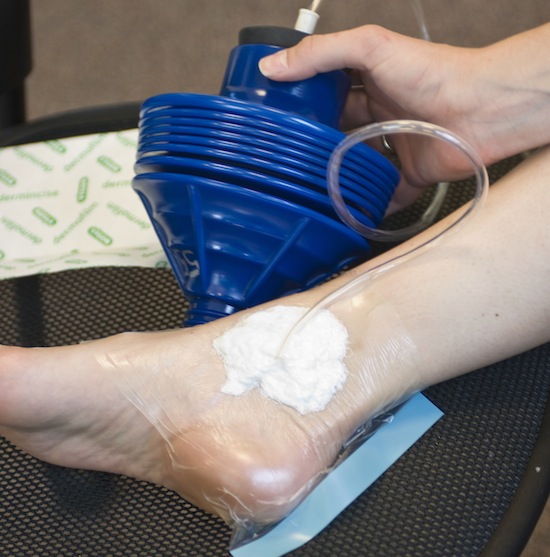
The medical field has known for some time now that negative pressure (re: suction) can drastically speed up wound recovery time. However, the machines that are currently available are quite expensive, and not an option for third world countries. Enter MIT student Danielle Zurovcik. The doctoral student has created a hand-powered suction-healing system that could completely revolutionize first aid in developing nations. Her device goes for only 3 bucks a pop.
"The device is composed of an airtight wound dressing, connected by a plastic tube to a cylinder with accordion-like folds. Squeezing it creates the suction, which lasts as long as there's no air leak. What's more, where regular dressings need to be replaced up to three times a day--a painful ordeal--the new cuff can be left on for several days.
Zurovcik originally intended to field-test the device in Rwanda, but then the Haiti Earthquake struck. At the request of Partners in Health, an NGO, she traveled to Haiti with 50 of the pumps.
Currently, Zurovcik is verifying the healing benefits of the device, and developing a new model that can be readily carried and concealed. The one technical hurdle that remains is ensuring the bandage seals tightly--but after that, the device could benefit a huge portion of the 50-60 million people in the developing world that suffer from acute or chronic wounds."